A moving target problem Tumor motion, due to respiration, peristalsis and organ deformation severely limits the effectiveness of radiation therapy. To compensate for tumor location uncertainty due to motion, safety margins are typically added to the prescribed tumor volume prior to treatment. Tumor motion due to respiration Due to these increased margins, the total desired radiation dose must be delivered over a series of smaller fractions (typically 30-40, over a 5 week period) in order to minimize toxicity to healthy tissue surrounding the tumor. Radiation oncologists are therefore faced with the following trade-off: "Maximizing dose to tumor for higher cure rates while minimizing collateral damage to healthy tissue" Existing motion solutions do not extend to multiple-targets Many attempts to solve the tumor-motion problem (and safely increase dose to tumor) are commercially available or under development, including: X-ray guided therapy, respiratory gating, implantable beacons and MRI-guided therapy. Unfortunately, these methods have serious drawbacks and limitations:
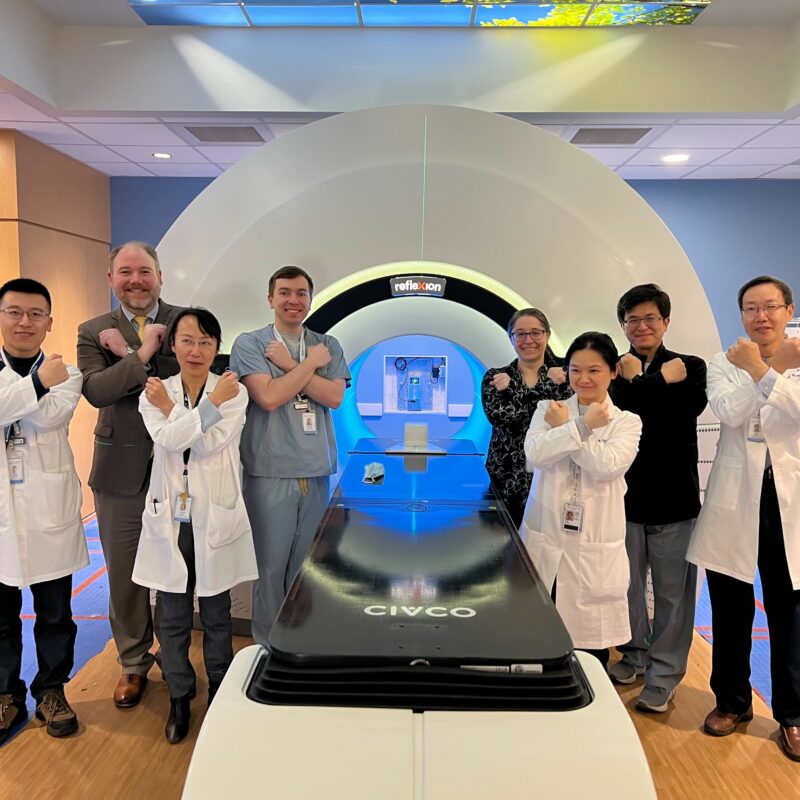
PET is promising but is not currently used during treatment Positron Emission Tomography (PET) is emerging as the imaging standard in cancer detection and diagnosis, offering higher sensitivity and specificity compared to all other imaging modalities across the majority of cancer types. With the use of a radio-labeled tracer called FDG, PET depicts metabolic activity, and causes tumors to “light up”. Other PET tracers such as F-MISO and FLT can identify distinct characteristics of tumors such as hypoxia and cellular proliferation. CT Image FDG-PET Image The combination of PET and radiotherapy has significant potential, since signals originating from tumors throughout the body can be harnessed directly to adapt treatment. However, until now PET has not been incorporated into treatment delivery since it takes minutes to generate a reasonable quality image and therefore, is unsuitable to compensate for motion caused by respiration and other bodily functions. The RefleXion system has not been cleared by the FDA for commercial use.
Copyright © 2010-2013, RefleXion Medical Inc. All Rights Reserved. |